
• Skip to main content
  • Skip to navigation
  • Accessibility
  • Contact Us
Government of Western Australia Crest
Government of Western Australia
Government of Western Australia Crest

Additional Menu

  • Accessibility
  • Contact us
Go to WA Government search
  • About us
    • About CAHS
    • Health Service Board
      • Frequently asked questions
    • Executive team
    • Our performance
    • Annual Reports
    • Strategies and plans
    • Acknowledgement of Country
    • Conduct standards
      • Public Interest Disclosure
      • Reporting misconduct
    • Annual Excellence Awards
    • Contact us
  • Our services
    • Neonatology
      • Neonatal Units
      • For parents and carers
      • Newborn Emergency Transport Service
      • The Perron Rotary Express Milk (PREM) Bank
      • Neonatal Follow up Program
      • Neonatology Clinical Research
      • Neonatology clinical guidelines
      • NETS WA clinical guidelines
      • Compliments and complaints
      • Neonatology Resources
      • Contact us
    • Community Health
      • Aboriginal Health Team
      • Child Health
      • Child Development Service
      • Immunisation
      • Refugee Health
      • School Health
      • Healthy Lifestyle Program
      • Bedwetting program
      • Compliments and complaints
      • Contact us
    • Mental Health
      • About us
      • Get help
      • Your healthcare rights
      • CAMHS Crisis Connect
      • Community CAMHS
      • Specialist services and day programs
      • Hospital services
      • Aboriginal Mental Health
      • For families and young people
      • Compliments and complaints
      • Contact us
    • Perth Children's Hospital
    • Children's Hospice Project
    • Community Hubs
    • First 1,000 Days Framework
  • For families and carers
    • COVID-19
      • Visiting CAHS sites
      • COVID-19 and children
      • Vaccination
      • Resources
    • Accessing or updating medical records
    • Being involved in your child's care
      • Your healthcare rights
      • Your child's medical record
      • Informed consent
      • Shared decision making
    • Consumer engagement
      • Become a consumer representative
      • Community Ambassador Program
      • Consumer groups and committees
      • Consumer Engagement Strategy
    • Compliments and complaints
      • Feedback form
      • You Said, We Did
      • Stars of CAHS Awards
    • Safety and quality of care
      • Preventing infections
      • Patient safety
      • Protecting the vulnerable
      • Listening and communicating with our consumers
    • QRious Health Hub for young people
    • Resources
    • Telehealth
  • For health professionals
    • Work with us
      • Careers at CAHS
      • Our vacancies
      • Why work for us?
    • Resources
      • Community Health Clinical Nursing Manual
      • CAHS Clinical Disclaimer
      • Neonatology guidelines
      • Neonatology Postnatal Ward guidelines
      • Newborn Emergency Transport Service WA guidelines
      • Schools and Child Care
    • CAHS Medical Library
    • CAHS Child Safeguarding Unit
    • Referrals to our services
      • Community Health
      • Mental Health
      • Newborn Emergency Transport Service
  • Research
    • For families
    • For researchers
      • Ethics and governance
      • Support and development
      • Research Education Program
      • Events
      • Resources
    • Explore our research
      • ACORN project
      • Early Moves
      • FH in Kids
      • Food Allergy Clinical Research Program
      • Healthy Lifestyle Program
      • Move to Improve
      • Safer Care for Children in Hospital research program
      • Research by department
    • For industry and sponsors: clinical trials
  1. Home
  2. News
  3. 2026
  4. 08
  5. 14
  6. World-first skin imaging study aims to improve care for premature babies

World-first skin imaging study aims to improve care for premature babies
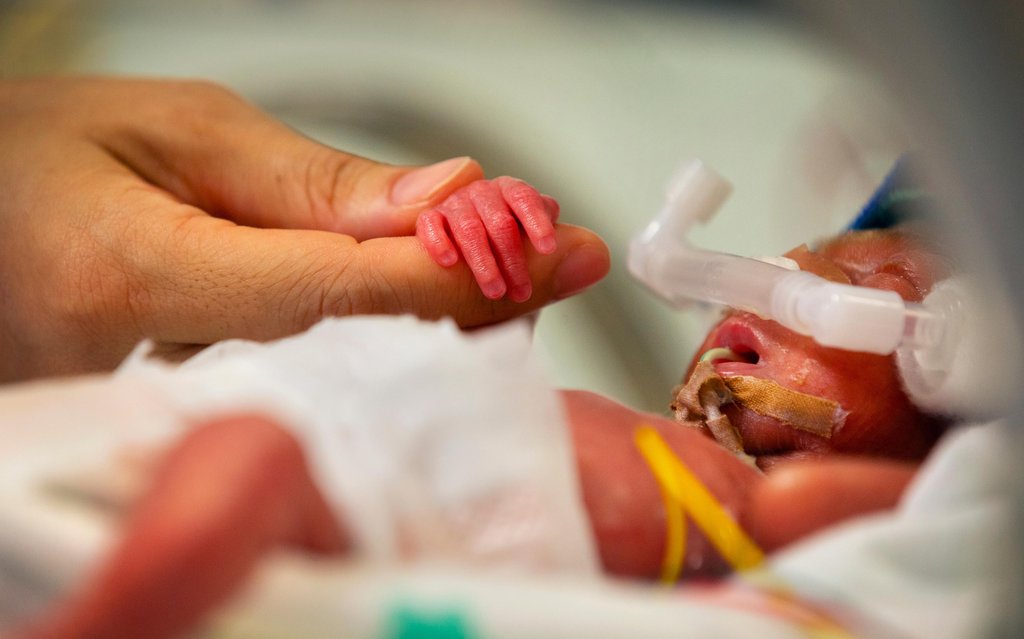
World-first skin imaging study aims to improve care for premature babies

Baby Iris - one of the first neonatal babies to have her skin examined with the DeepLive Optical Coherence Tomography scanner. Baby Iris is one of the first babies to have her skin examined with the DeepLive Optical Coherence Tomography scanner. Credit: Ross Swanborough/The West Australian
18/11/2025

A world-first study based at King Edward Memorial Hospital (KEMH) is using advanced imaging technology to better understand the fragile skin of preterm babies and help prevent skin injuries that can lead to serious infections.

The DeepLive Optical Coherence Tomography (OCT) scanner is being used in neonatal care for the first time anywhere in the world, allowing clinicians and researchers to view detailed, three-dimensional images of newborn skin without the need for invasive procedures.

Child and Adolescent Health Service (CAHS) Consultant Neonatologist Dr Tobias Strunk is leading the study, which aims to improve outcomes for some of the hospital’s smallest and most vulnerable patients.

"Skincare really has emerged as one of the challenges looking after our tiniest babies, because the skin is so immature and really not made to come in contact with the outside world just yet," Dr Strunk said.

The skin plays a critical role in protecting babies during the first weeks of life.

"It (skin) provides the mechanical and chemical barrier that is essential to protect babies from infections," Dr Strunk said.

"We know that poor skin integrity is closely related to the risk of acquiring infections that can be life-threatening to babies."

In WA’s specialist neonatal units, around half of extremely preterm babies develop skin injuries during their first two weeks of life. Researchers hope the new technology will provide insights into how skin develops, how injuries occur and how they can be prevented.

"We are really asking, how does the skin mature? What injures the skin and how can we prevent it? And which therapy works best?" Dr Strunk said.

The non-invasive scanner can be used at the bedside, similar to an ultrasound, enabling clinicians to monitor fragile skin throughout a baby's neonatal intensive care journey.

According to Dr Strunk, the technology provides a level of detail that has not previously been available in neonatal care.

"It's a fantastic new development. It's a machine that provides us with very detailed images of a newborn's skin, just like we were looking under the microscope, but without having to take a skin sample," he said.

Researchers are investigating whether the technology can identify signs of skin stress and damage before they become visible to the human eye.

"The machine provides such detailed imaging that we hope that in the future, we'll be able to tell the injuries to the skin are occurring before our eyes can pick it up," Dr Strunk said.

"We could only look with our naked eye, so when the skin becomes red and it looks dry, it's probably too late. We need to know earlier and this may be the tool that tells us when to act before our eyes can tell us."

The study has already recruited babies receiving care in the CAHS neonatal intensive care unit based at KEMH, with researchers hoping the findings will help reduce skin injuries, infections and long-term complications for preterm infants.

The DeepLive OCT scanner was secured through the support of Telethon and Mineral Resources for the pilot study.

Watch Channel 7's coverage of the world-first study:
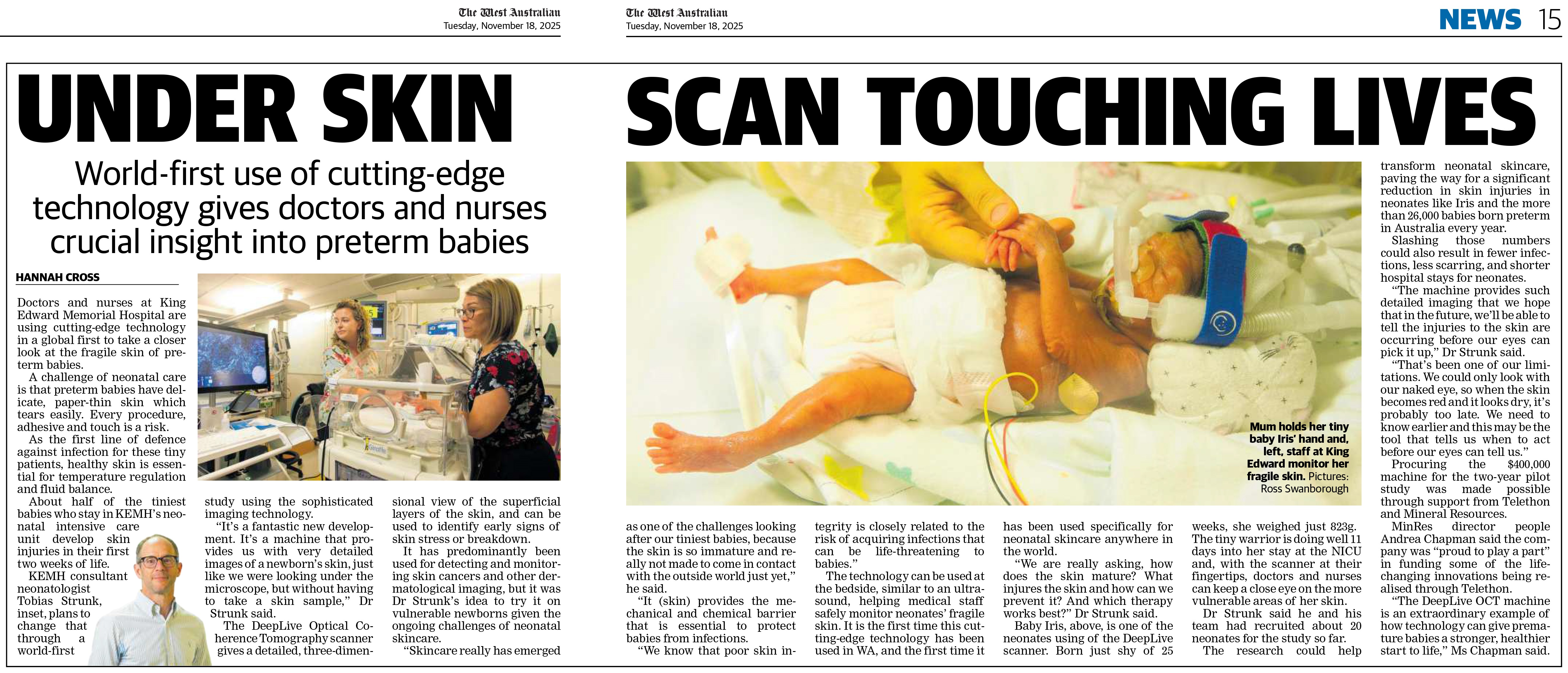
  

Read more in The West Australian newspaper article below, published 18 November 2025, pages 14-15

The West Australian, 18 November 2025, pages 14-15

Previous Next
Last Updated: 17/08/2026
  • Facebook
  • Instagram
  • YouTube

Footer menu

  • wa.gov.au
  • Copyright
  • Disclaimer
  • Privacy
  • Sitemap
  • Contact Us

Brought to you by the Department of Health, Western Australia

© Government of Western Australia 2018 to