

Triple research success for CAHS newborn health studies
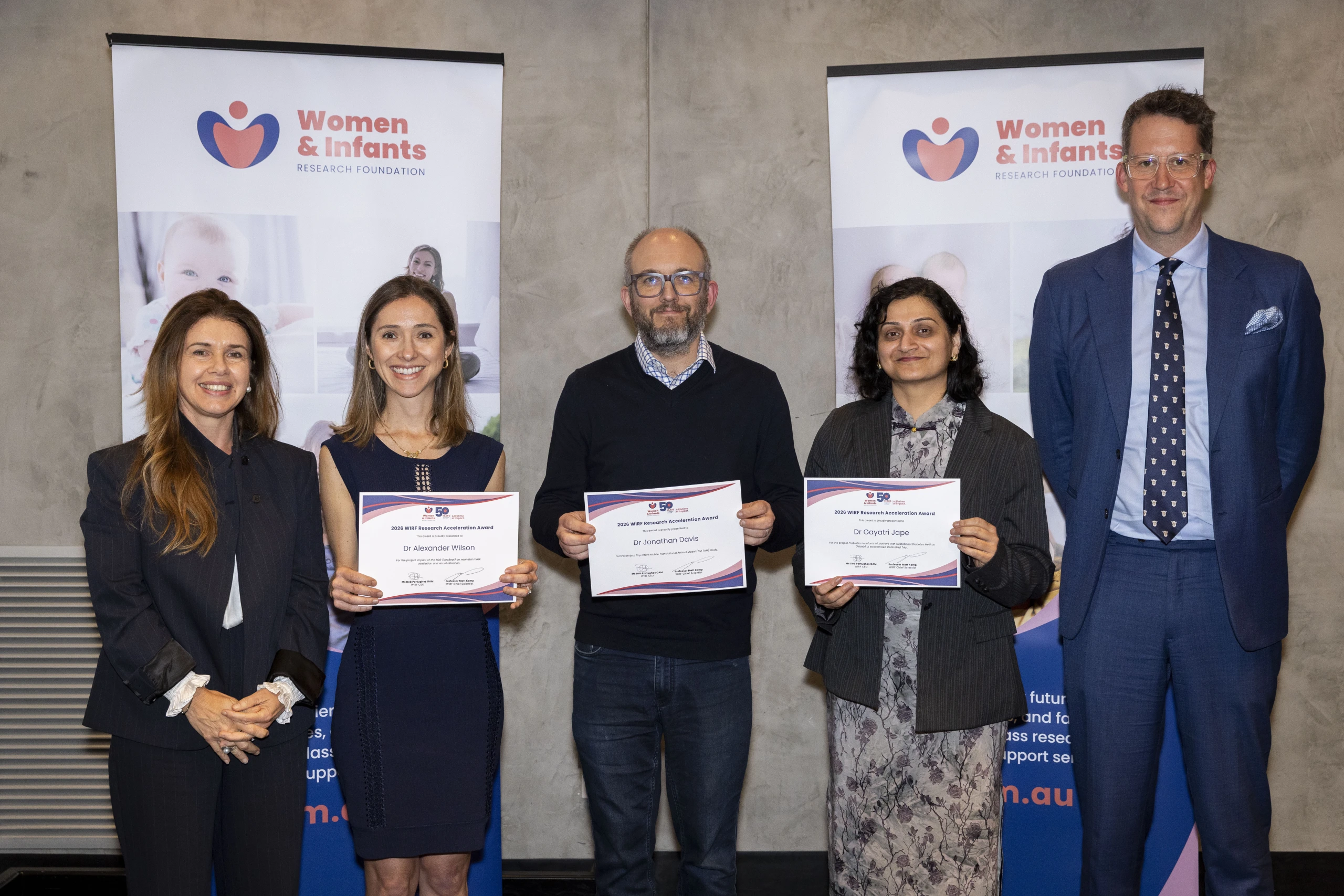 From left: Deb Portughes OAM (WIRF CEO), Diana Aguirre (from Dr Alexander Wilson’s research team), Associate Professor Jonathan Davis, Associate Professor Gayatri Jape and Professor Matt Kemp (WIRF Chief Scientist).
Three Child and Adolescent Health Service (CAHS) research projects aimed at improving outcomes for newborns have received funding through the Women and Infants Research Foundation's 2026 Research Acceleration Awards.
One of the successful projects will investigate whether probiotic supplements can improve health outcomes for babies born to mothers with gestational diabetes.
The study's lead, Neonatologist Associate Professor Gayatri Jape, says gestational diabetes mellitus (GDM) is one of the most common complications of pregnancy, affecting about one in five pregnancies. Babies born to mothers with GDM are at increased risk of obesity, type 2 diabetes and neurodevelopmental challenges later in life.
"Our study responds to emerging research that suggests GDM alters the infants gut microbiome which plays a role in metabolism, immune function and brain development," A/Professor Gayatri says.
"We hope that if we can restore a healthier gut microbiome in these infants using probiotic supplementation, we can also improve their long-term health outcomes."
"If successful, this would be an important breakthrough involving a simple, safe and low-cost intervention."
The other two CAHS projects awarded funding in the program are studies by the WA Neonatal Emergency Transfer Service’s (NETS) Medical Director Associate Professor Jonathan Davis, and Neonatal Retrieval Consultant, Dr Alexander Wilson.
The pair’s projects are part of the Neonatal retrieval and resuscitation research strategy which is tackling healthcare inequity faced by WA babies born far from the highest level of care.
Jonathan revealed that 3 per cent of all babies born in WA each year needed transport to higher-level care and that Aboriginal families were significantly over-represented in this group.
“By improving resuscitation outcomes outside the big tertiary hospitals and our understanding of how transport impacts newborns from rural and remote WA, our research will help close this gap,” he said.
Jonathan’s project will investigate how environmental factors experienced during newborn transportation such as temperature fluctuation, vibration and pressure changes, affect newborn brain and lung development. The study’s findings will be used to enhance neonatal transport practices, with the goal of improving the health outcomes of newborns requiring a long-distance transfer.
Alexanders’s study will evaluate whether use of new heart-rate monitoring technology, when used in infant resuscitations, can improve outcomes by keeping the clinician’s gaze more focused on the infant. Because the NeoBeat device is positioned on the infant’s chest, there is less need for the clinician to avert their gaze to check bedside monitors. This momentary shift in gaze has been associated with reduced quality of ventilation needed for effective resuscitation.